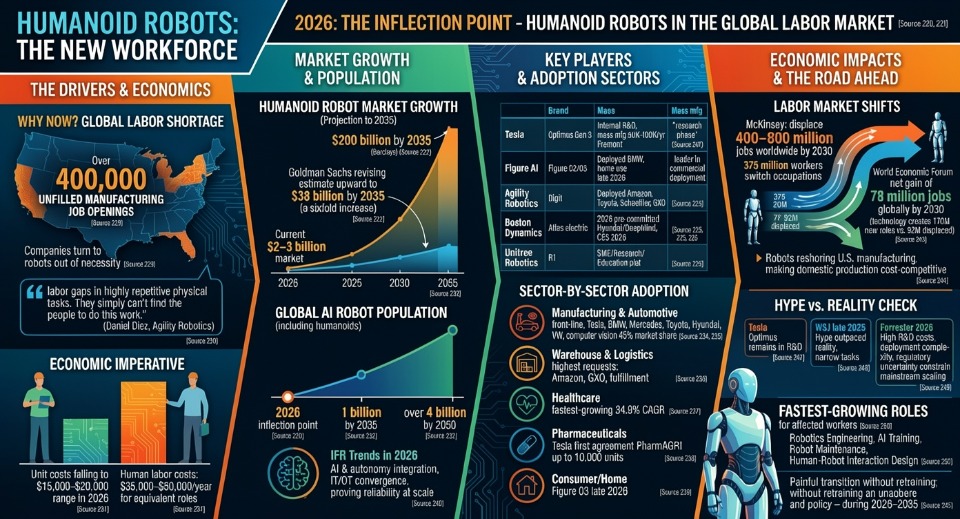
2026: The Inflection Point
2026 is widely recognized as the year humanoid robots transition from impressive demos to real industrial deployments — a structural shift in global labor markets that was theoretical just two years ago. The humanoid robot market, currently valued at $2–3 billion, is projected to reach $200 billion by 2035, according to Barclays research, and Goldman Sachs has revised its market estimate upward to $38 billion by 2035, a sixfold increase from earlier projections.
Key Players & Deployments
The competitive landscape is being shaped by a few dominant firms, each at different stages of commercial readiness:
Figure AI stands out as the furthest along in external commercial deployment — its Figure 02 robots are performing actual factory tasks at BMW, not just internal testing, as of March 2026. Boston Dynamics unveiled its fully electric Atlas product version at CES 2026, with all 2026 units already pre-committed to Hyundai and Google DeepMind.
Why Now? The Labor Gap Driver
The single most powerful demand driver is a global manufacturing labor shortage, not robot hype. With over 400,000 unfilled manufacturing job openings in the U.S. as of December 2025, companies are turning to humanoid robots out of necessity. Agility Robotics' chief business officer Daniel Diez confirms the same story globally: "In Germany, Korea, Japan, or the US — it's the same exact issue: labor gaps in highly repetitive physical tasks. They simply can't find the people to do this work."
The economics are becoming compelling fast. Unit costs are already falling toward the $15,000–$20,000 range in 2026, compared to $35,000–$50,000/year in human labor costs for equivalent roles. A Citi report projects the global population of AI robots (including humanoids) will reach 1 billion by 2035 and over 4 billion by 2050.
Sector-by-Sector Adoption
- Manufacturing & Automotive: Front-line adopters — Tesla, BMW, Mercedes-Benz, Toyota, Hyundai, and Volkswagen are all actively piloting or deploying; computer vision commands 45% market share in enabling machine perception.
- Warehouse & Logistics: Amazon, GXO, and e-commerce fulfillment centers represent the highest "inbound" requests for humanoid robot deployment.
- Healthcare: Fastest-growing adoption segment, at 34.9% CAGR, driven by aging populations and caregiver shortages.
- Pharmaceuticals: Tesla signed its first external Optimus purchase agreement with PharmAGRI for up to 10,000 units for drug manufacturing and farm operations.
- Consumer/Home: Figure AI's Figure 03 is targeting residential deployment by late 2026, which would mark a major milestone.
The International Federation of Robotics (IFR) identifies AI & autonomy integration, IT/OT convergence, and proving humanoid reliability at scale as the top 2026 trends.
Economic & Labor Market Impact
The macro picture is both promising and sobering. McKinsey Global Institute estimates that automation (including humanoids) could displace 400–800 million jobs worldwide by 2030, forcing up to 375 million workers (~14% of the global workforce) to switch occupations entirely. However, the World Economic Forum's 2025 Future of Jobs Report projects a net gain of 78 million jobs globally by 2030, with technology creating 170 million new roles while displacing 92 million.
Robots are also reshaping the reshoring of U.S. manufacturing — humanoid robots make domestic production cost-competitive with overseas labor, potentially reversing decades of offshoring. However, CNBC and labor economists warn that the transition period from 2026–2035 will be economically painful for affected workers without proactive retraining programs and policy intervention.
Hype vs. Reality Check
- Not everyone is bullish on the pace. Tesla's Optimus remains officially in R&D, with Elon Musk noting internal factory deployment is still a "research phase".
- A late-2025 Wall Street Journal report warned that hype has "outpaced reality," with humanoid robots still performing only simple, narrow tasks in limited real-world deployments.
- Forrester's 2026 State of Humanoid Robots report confirms that while early adopters are capturing emerging use cases, high R&D costs, deployment complexity, and regulatory uncertainty will constrain mainstream scaling.
- The consensus among labor economists as of March 2026: humanoid robots will displace millions of jobs in specific sectors this decade, but new roles in robotics engineering, AI training, robot maintenance, and human-robot interaction design are emerging as some of the fastest-growing careers ahead.
About the Author
Nay Linn Aung is a Senior Automation & Robotics Engineer (M.S. Computer Science — Data Science & AI) specializing in the convergence of OT and IT.