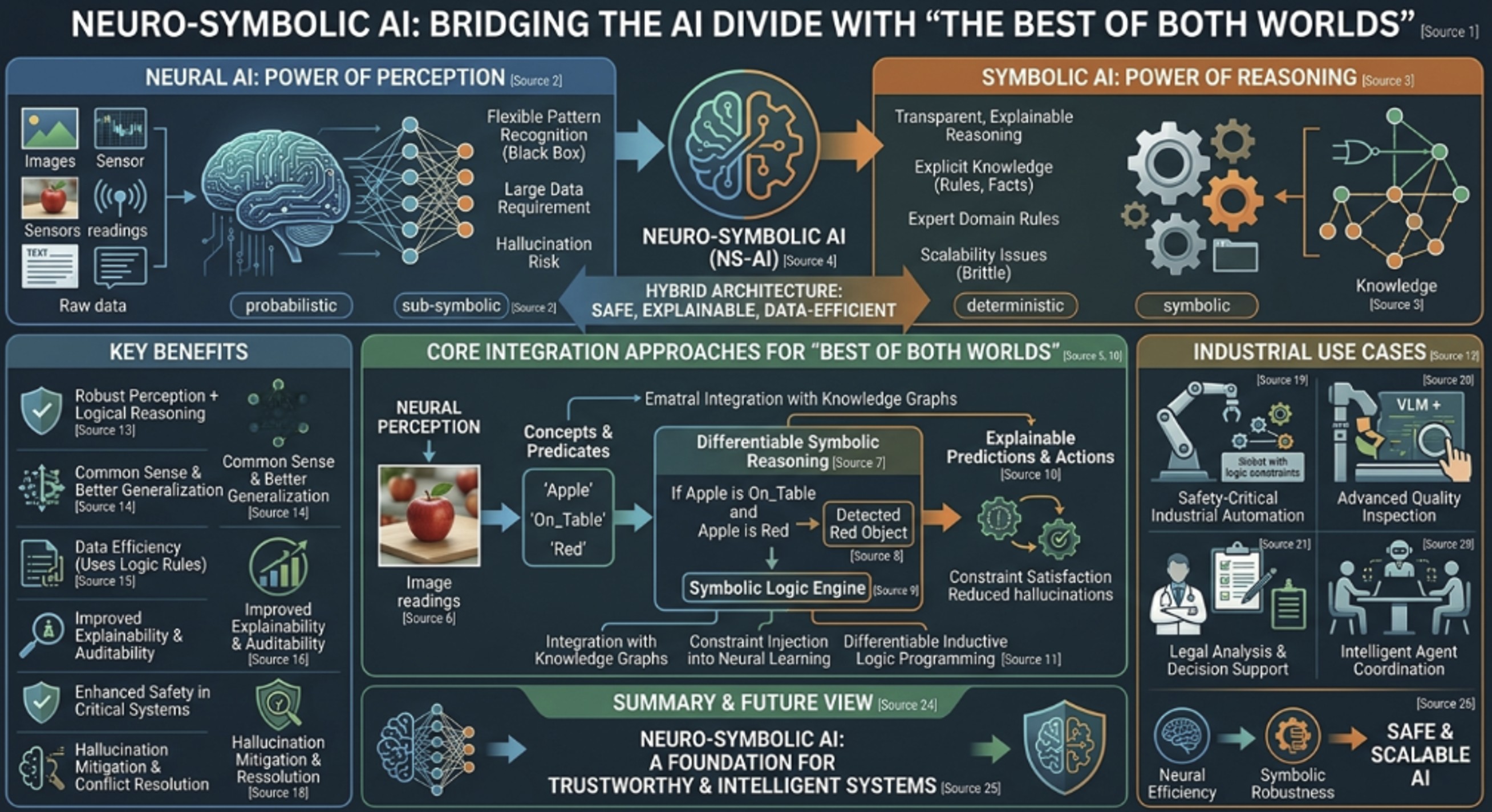
Neuro-Symbolic AI: The Best of Both Worlds
Neuro-symbolic AI (NeSy AI) is rapidly transitioning from a research curiosity to a production-ready paradigm — combining the pattern-recognition power of neural networks with the logical rigor of symbolic reasoning. As of March 2026, it is widely regarded as the most significant architectural shift in AI since the deep learning revolution of 2017.
Breakthrough: 100x Energy Reduction (March 22, 2026)
The most significant news published just yesterday comes from Tufts University's School of Engineering. Researchers led by Professor Matthias Scheutz have developed a proof-of-concept neuro-symbolic AI system for robotics that uses 100 times less energy than conventional visual-language-action (VLA) models — while dramatically outperforming them.
- In Tower of Hanoi tests, the neuro-symbolic VLA achieved a 95% success rate, vs. only 34% for standard VLAs
- For novel, unseen puzzle variants, neuro-symbolic scored 78% while standard VLAs failed every single attempt
- Training time dropped from over 36 hours to just 34 minutes, using only 1% of the energy of conventional training
- During task execution, the neuro-symbolic model consumed only 5% of the energy of standard VLA models
The paper, titled "The Price Is Not Right: Neuro-Symbolic Methods Outperform VLAs on Structured Long-Horizon Manipulation Tasks with Significantly Lower Energy Consumption", is published on arXiv (DOI: 10.48550/arxiv.2602.19260) and will be presented at the International Conference on Robotics and Automation (ICRA) in Vienna, May 2026.
New Landmark Survey (March 3, 2026)
A comprehensive academic survey — "Neuro-Symbolic Artificial Intelligence: A Task-Directed Survey in the Black-Box Models Era" — was submitted to arXiv on March 3, 2026, authored by Delvecchio, Molfetta, and Moro of the University of Bologna. Accepted and published at IJCAI-2025, this paper maps out task-specific NeSy advancements, showing how symbolic systems elevate explainability and reasoning in domains where LLMs fall short. It serves as a critical reference for researchers building explainable AI systems for real-world applications.
Legal & Policy Compliance (March 2, 2026)
Forbes contributor Lance Eliot highlighted a powerful enterprise use case: neuro-symbolic AI enabling policy and legal adherence in generative AI output. By layering symbolic rules over neural generation, organizations can enforce regulatory compliance — eliminating the hallucination-driven liability that plagued first-generation LLMs. This is especially relevant to financial services, healthcare, and legal tech sectors where output accountability is non-negotiable.
Clinical Diagnostics & Healthcare
Neuro-symbolic architectures are replacing opaque deep learning models in clinical neurology. A landmark MIT CSAIL paper in Nature Machine Intelligence (Sarkar et al., 2025) demonstrated a NeSy system for epilepsy diagnosis achieving 97.3% accuracy on EEG data — with human-readable reasoning explanations citing specific waveform features and anatomical localizations. Analysts predict neuro-symbolic AI will receive FDA 510(k) clearance for at least one clinical neurology application by Q2 2027.
The "Dual-System" Architecture — Why It Works
NeSy AI mirrors the System 1 / System 2 cognitive framework described by Daniel Kahneman:
This hybrid means a surgical robot in 2026 doesn't need 10 million training examples of an appendectomy — it's given symbolic anatomical rules and uses neural vision to adapt them to each unique patient.
Academic Community: NeSy 2026 Conference
The NeSy 2026 Conference (Neurosymbolic Learning and Reasoning) has issued a call for papers, inviting theoretical, experimental, and applied submissions on the integration of neural networks and symbolic AI. This signals the field's maturity from fringe research into a mainstream academic discipline.
Why 2026 Is the Inflection Point
Several convergent forces are making this the decisive year for NeSy adoption:
- Regulatory pressure: EU AI Act and U.S. frameworks increasingly demand explainable, auditable AI decisions
- Enterprise governance: Businesses now ask not just can AI perform, but can AI explain and defend its decisions
- Energy economics: The IEA estimates U.S. AI/data centers consumed 415 terawatt-hours in 2024 — over 10% of national output — expected to double by 2030, making NeSy's efficiency gains strategically critical
- Infrastructure readiness: Cloud-native platforms now support the layered orchestration that NeSy architectures require
- Hybrid NeSy-RAG: 2026 is expected to be the year of Hybrid Neuro-Symbolic RAG systems, moving beyond LLM wrappers to deeper symbolic integration for math, logic, physics, and precise sciences
- The paradigm shift is clear: pure deep learning is hitting a wall of resource consumption, opacity, and governance risk — and neuro-symbolic AI is the architecture being built to replace it.
About the Author
Nay Linn Aung is a Senior Automation & Robotics Engineer (M.S. Computer Science — Data Science & AI) specializing in the convergence of OT and IT.