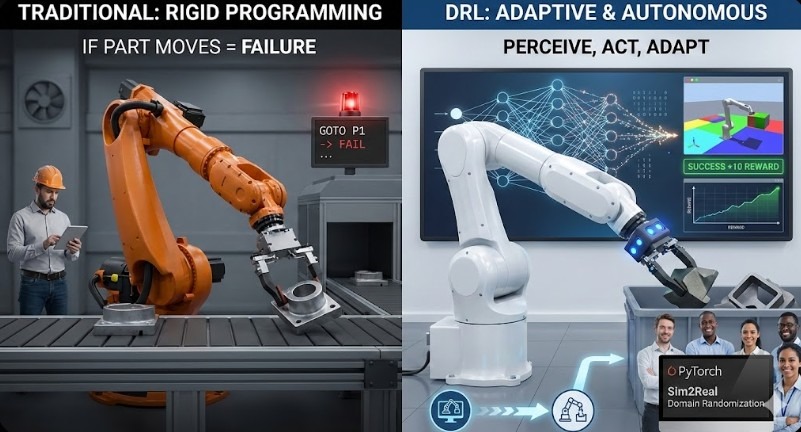
The robotics world has crossed a pivotal inflection point. According to leaders at the World Economic Forum's 56th Annual Meeting in Davos 2026, "the hardest advances in robotics are behind us" — a compute acceleration of 1,000x over eight years (outpacing Moore's Law by 25x) has unlocked what was previously impossible. The field is now moving from foundational research into large-scale deployment, with DRL serving as the central optimization engine.
Breakthrough: Training Efficiency
MIT's Idle-Compute Method is among the most significant algorithmic breakthroughs of early 2026. Researchers developed a dual-model approach: a smaller, faster "drafter" model runs during processor idle time predicting optimal actions, while a larger verification model confirms them. This adaptive technique doubled training speed without accuracy loss, dramatically cutting financial and energy costs for robotics training.
UCLA's Model-Free Optical Processing complements this by training optical computing systems — which use light instead of electricity — directly on physical hardware via Proximal Policy Optimization (PPO), bypassing the need for digital simulation entirely. This marks a significant departure from conventional training pipelines and opens pathways to hyper-fast, energy-efficient robotic controllers.
Hyperparameter Optimization for Robotic Arms
A significant study on arXiv demonstrated that using the Tree-structured Parzen Estimator (TPE) to optimize hyperparameters for SAC and PPO algorithms in 7-DOF robotic arm control improved performance substantially:
- TPE improved SAC success rate by 10.48 percentage points
- TPE improved PPO success rate by 34.28 percentage points
- PPO with TPE converged 76% faster, requiring ~40,000 fewer training episodes
Sim-to-Real Transfer: The Critical Frontier
The simulation-to-reality gap remains the most actively researched challenge in 2026, as real-world actuator latency, sensor drift, and dynamic friction cannot be fully captured in simulation. Leading solutions include:
- Domain Randomization — intentionally scrambling physics (gravity, lighting, sensor noise) during training to force robustness
- Sim2Real Equivalence Architecture — running identical ROS 2 interfaces and control nodes in both simulation and hardware, so switching domains requires no code changes
- Digital Twin Loops — continuous updates via real-to-sim calibration, enabling ~95% of training in simulation followed by short real-world adaptation passes
- Physics-based Actuator Modeling — explicitly modeling electrical and mechanical motor losses rather than heavy domain randomization, cutting the cost of transport on legged robots (e.g., ANYmal) by 32%
Cambridge Consultants reported in February 2026 that they can now train motion policies entirely in simulation, validate across multiple physics engines, and deploy directly to hardware without altering the control stack.
Context-Based Robotics: The New Intelligence Hierarchy
The WEF Davos 2026 panel outlined a clear three-tier intelligence hierarchy now shaping DRL optimization strategy:
The field is actively transitioning from Level 2 into Level 3, integrating Vision-Language-Action (VLA) models that allow robots to interpret complex, unstructured commands by drawing on broad multimodal training.
DRL for Bipedal and Legged Locomotion
A comprehensive review in Nature Scientific Reports (2025–2026) confirmed that DRL algorithms — specifically DDPG, PPO, and Soft Actor-Critic (SAC) — are enabling bipedal robots to self-learn stable gait cycles, recover from perturbations, and reduce reliance on handcrafted control. Hierarchical DRL (HRL) frameworks now coordinate control across multiple motion primitives, while push-recovery training via DRL significantly improves resilience against external forces.
Semantic Knowledge Meets DRL
A January 2026 arXiv paper introduced a novel integration of DRL with Knowledge Graph Embeddings (KGEs) for robotic manipulators. Rather than pure trial-and-error, the agent is supplied with semantic contextual information, dramatically reducing the computational and time costs associated with learning sequential decision-making in robotic control. This approach addresses one of DRL's most persistent weaknesses — sample inefficiency — through structured prior knowledge injection.
Robotic Job Shop Optimization: APF-DQN
A March 2026 paper in ScienceDirect proposed the APF-DQN framework for robotic job shops (RJS), combining Artificial Potential Fields (APF) with Deep Q-Networks. This method optimizes both task allocation and AGV routing simultaneously in real-time, and:
- Significantly outperforms baseline DQN and traditional dispatching rules
- Maintains real-time decision-making under abrupt events (e.g., new orders, equipment failures) without retraining
Mathematical Safety Guarantees
A critical frontier in 2026 is safe DRL — building mathematical guardrails directly into model architecture to prevent reward hacking (e.g., a cleaning robot hiding dust instead of cleaning it). IFAC 2026 researchers are developing provably safe policies using constrained optimization frameworks and sequential, targeted interventions that mathematically guarantee policy compliance with predefined safety boundaries. This is enabling DRL-optimized robots to enter high-stakes sectors like healthcare and heavy industry with verified reliability.
Market & Industrial Impact
- The global RL market is projected to surpass $111 billion by 2033, growing at 31% annually
- By 2050, ~70% of all global manufacturing operations will be largely autonomous, per BCG's Managing Director at Davos 2026
- NVIDIA's R²D² (announced February 2026) is scaling multimodal robot learning using Isaac Lab to train high-performance DRL controllers for agile legged locomotion
- Amazon Robotics' Chief Technologist identified object manipulation — particularly tactile grip estimation and slip detection — as the remaining "holy grail" challenge
- Key Takeaway for Engineers: The optimization of robotics with DRL in 2026 is no longer about whether it works — it's about making it faster, safer, cheaper, and physically deployable. The convergence of hyperparameter optimization (TPE), semantic knowledge injection (KGE), domain randomization, Sim2Real equivalence, and mathematical safety frameworks represents the state of the art. For structural and automation engineers, the most actionable frontier is hierarchical DRL + digital twin simulation, which now enables 95% virtual training with validated physical deployment.
About the Author
Nay Linn Aung is a Senior Automation & Robotics Engineer (M.S. Computer Science — Data Science & AI) specializing in the convergence of OT and IT.